
Montgomery County Criminal Court Records
A Montgomery County criminal court record is the case file kept by the Clerk of the District Court after the prosecutor files state-law charges in District Court. The file can include the complaint or information, charge statutes, probable-cause material, summonses or warrants, bond orders, hearing notices, motions, plea entries, docket events, sentencing journal entries, probation orders, restitution, fines, costs, and collection events. The full criminal case file is broader than the charge line that may appear at booking. A custody entry can be brief. The court file shows how the case moved and what the court did.
Kansas District Courts are the general-jurisdiction trial courts. In Montgomery County, criminal cases are handled in the 14th Judicial District, which serves Montgomery and Chautauqua Counties. The main Montgomery County District Court office is in Independence, and a second Montgomery County court office operates in Coffeyville. City ordinance and some local traffic matters may be in municipal court instead of District Court, including Independence, Coffeyville, or Caney Municipal Court. That venue split matters because a municipal fine, city bench warrant, or ordinance violation may not appear as a District Court criminal case.
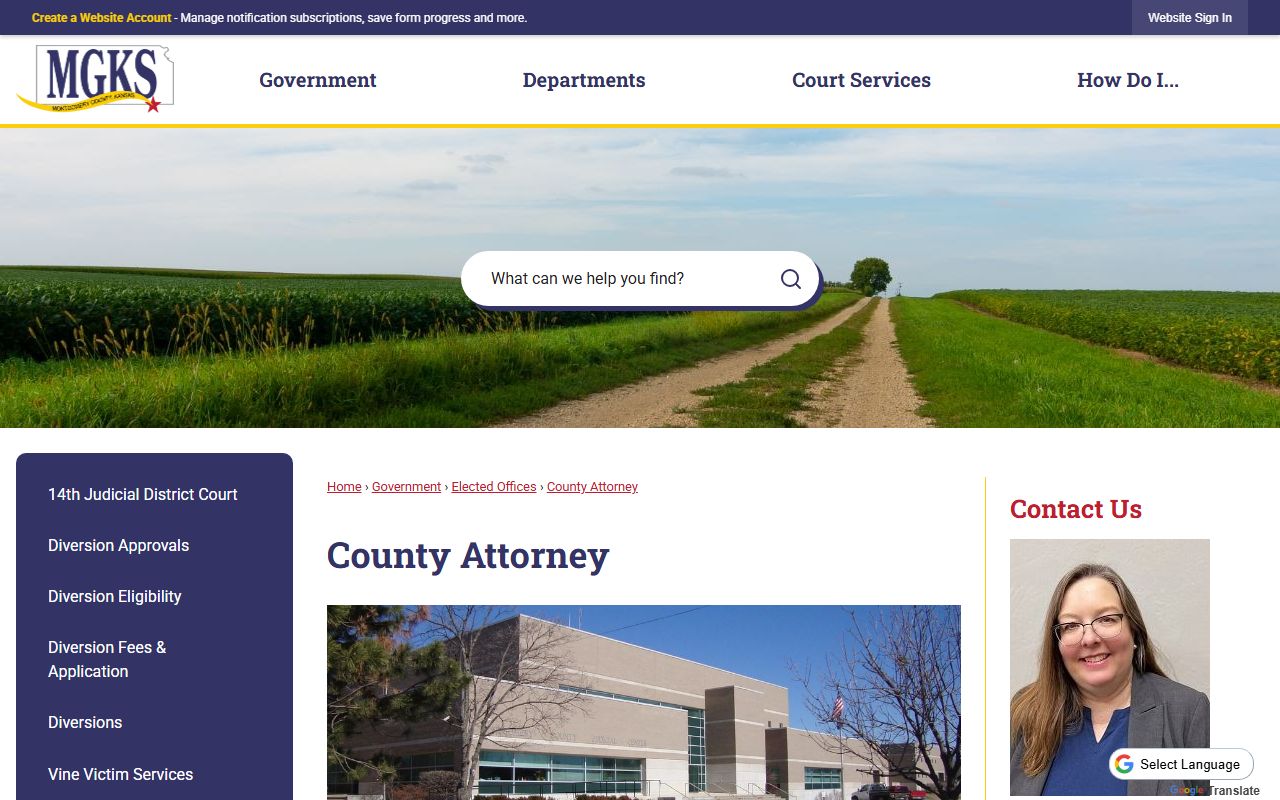
The Montgomery County Attorney's Office is the local prosecutor for state-law criminal charges. County sources name Melissa Johnson as County Attorney, with the office in the Judicial Center at 300 E. Main Street in Independence. The County Attorney works with law enforcement on charges after arrest, but the filed court record belongs with the Clerk of the District Court once the case is opened.
The official Montgomery County Attorney page shows where the prosecution office fits in the local criminal court process.
Search Montgomery County Criminal Records
Public District Court case information is searched through Kansas CaseSearch. The Kansas Judicial Branch says district court case information and records can be searched online or through public terminals at each courthouse. CaseSearch can support searches by case number, party name, business name, citation, or other criteria available for the user's role. If a document image is not available online, Kansas court guidance points requesters to a written document request, and the 14th Judicial District provides a public-records request form for local court records.
- Start with CaseSearch and search by the criminal case number if it is known.
- If no case number is known, search by defendant name and compare the case type, filing date, and court location.
- Read the docket entries for charge filings, arraignment, motions, continuances, plea events, disposition, sentencing, and probation review entries.
- Use the Montgomery County District Court counter or courthouse terminal when an older or non-electronic record is not available online.
- For copies, submit a written request to the Clerk of the District Court with the case number, party name, document title, filing date if known, and contact information.
The Clerk of the District Court accepts the local 14th Judicial District public records request form, mailed requests, and faxed requests for court records. The Independence court office is listed at 300 E. Main Street, Suite 201, Independence, KS 67301, phone 620-330-1070, fax 620-331-6120. The Coffeyville court office is listed at 102 W. 7th Street, 3rd Floor, Coffeyville, KS 67337, phone 620-251-1060, fax 620-251-2734. Public hours are Monday through Friday, 8:00 a.m. to noon and 1:00 p.m. to 4:00 p.m.
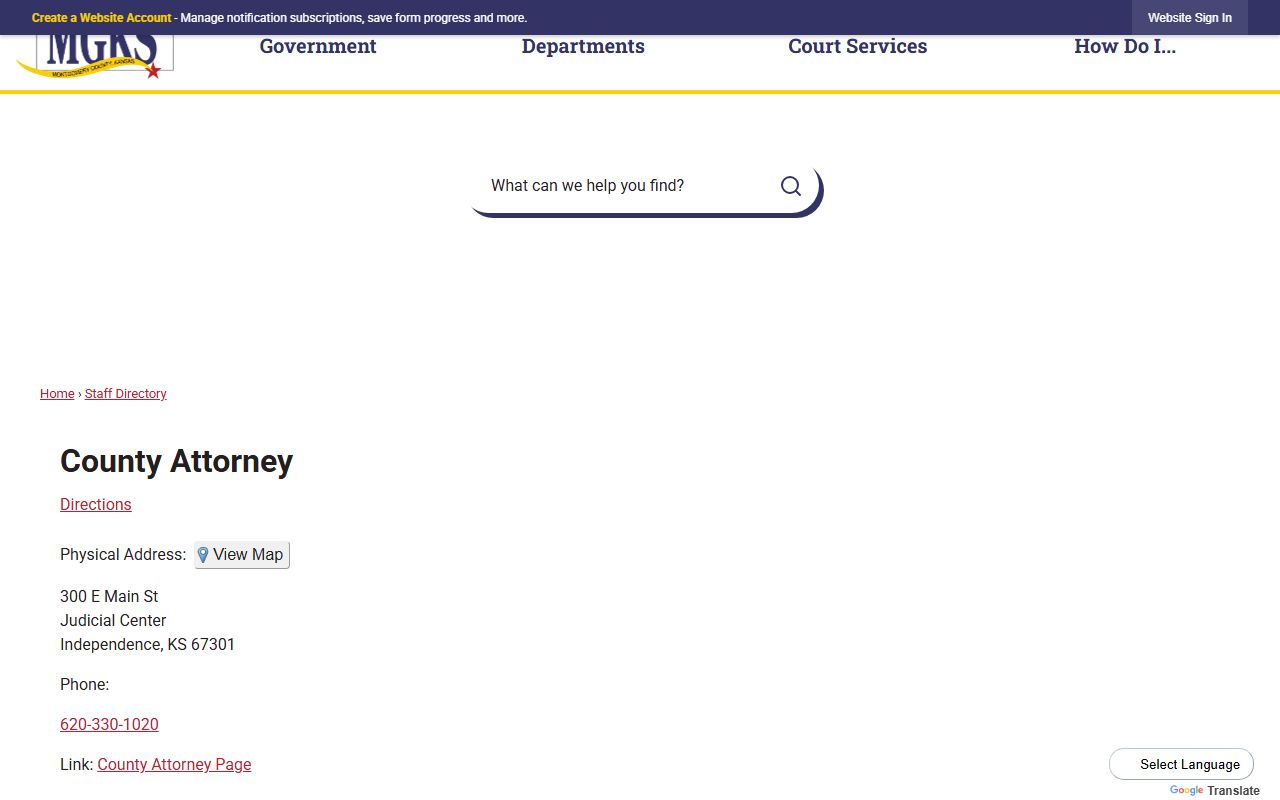
The County Attorney directory entry identifies the prosecutor's office hours and first-floor Judicial Building location.
Montgomery County Criminal Case Flow
Criminal court records are easiest to read as a sequence. The file starts with the charging document and then grows as the court schedules hearings, receives motions, enters orders, records pleas, and issues a final disposition or sentence. A docket is the chronological event list. A journal entry is a Kansas court order that memorializes a ruling, judgment, or sentence. A disposition is the current or final outcome of a charge or case.
Case flow: Charges Filed › Arraignment › Pretrial and Motions › Plea or Trial › Disposition › Sentencing.
- Charges filed
- The record may show a complaint or information, statutes, charge level, prosecutor, summons or warrant, and first bond entry.
- Arraignment and pretrial
- The record may show plea settings, counsel, bond review, motions, continuances, status hearings, and court orders.
- Plea, trial, and sentence
- The record may show plea agreements, verdicts, dismissals, sentencing journal entries, probation terms, restitution, fines, and costs.
Warrants and bond may also appear in the criminal file. A bench warrant is often tied to a missed hearing, contempt, probation violation, or failure to comply with a court order. Current custody, booking charges, and bond questions may also involve the Sheriff's Office, but the court record is still the place to confirm hearings, warrants issued or recalled by the court, dispositions, and sentencing entries.
Montgomery County Criminal Record Fields
A criminal case file can contain both searchable fields and filed documents. Search results usually give enough data to identify the case, but the key document may require a clerk request. Rule 22 also controls which electronic court records are open to the public, so the online view may be narrower than the courthouse record or the complete clerk file.
| Field | What It Shows |
|---|---|
| Case Number | Kansas case identifiers can include filing year, case type code, sequence number, and location or court prefix. |
| Case Type | Criminal case category, and sometimes related probation, traffic, or warrant activity inside the same court file. |
| Parties | The State as prosecuting party, the defendant, defense counsel, prosecutor, and sometimes related agency names. |
| Charges | Charge text, statute or code references, charge level, amended charges, dismissed counts, or counts carried to disposition. |
| Docket Entries | Hearings, motions, continuances, warrants issued or recalled, pleas, sentencing, probation reviews, and payment events. |
| Financial Terms | Bond, court costs, fines, restitution, collection balance, receipts, or referral to collection when shown in the case. |
| Documents | Complaint, information, bond order, plea entry, journal entry, sentencing order, probation order, or other filed papers. |
| Restrictions | Sealed portions, redacted identifiers, juvenile limits, domestic or protection-order limits, and other Rule 22 restrictions. |
For a closer look at the charge line that starts after booking, the arrest-to-charge pathway is covered separately in Montgomery County arrest records and charges. That distinction helps avoid treating a jail booking entry as the final court outcome.
Montgomery County Charges vs Convictions
A charge is an accusation filed or listed by law enforcement or the prosecutor. A conviction is the result of a guilty plea, verdict, or other court finding that establishes guilt. A criminal court record may show charges that were amended, dismissed, reduced, or resolved with no conviction. It may also show multiple counts from one event, with different outcomes for each count.
| Point | Charge | Conviction |
|---|---|---|
| Role in the case | Begins as an accusation or count in the charging document. | Reflects a final or accepted finding of guilt for a count. |
| Record language | May appear as pending, amended, dismissed, reduced, or filed in error. | May appear in the disposition, plea, verdict, or sentencing entry. |
| Proof level | Often tied to probable cause and prosecutorial charging decisions. | Requires a plea or proof beyond a reasonable doubt at trial. |
| Public meaning | Does not prove guilt by itself. | Can support sentencing, probation, restitution, and criminal-history consequences. |
KBI criminal-history searches are separate from the District Court case file. The Kansas criminal history record check is a public name-based search that costs $30 and is available during posted service hours. It can be useful for a statewide summary, but it is not a substitute for the filed complaint, docket, journal entry, or sentencing order in Montgomery County District Court.
Montgomery County Sealed and Expunged Records
Sealed and expunged records are not the same. A sealed case or sealed document is closed from ordinary public access by statute or court order. An expungement is a court process that restricts public access to eligible convictions, arrest records, or diversions under Kansas law. The local 14th Judicial District FAQ says some convictions cannot be expunged and that waiting periods may apply. It also recommends legal advice for eligibility questions.
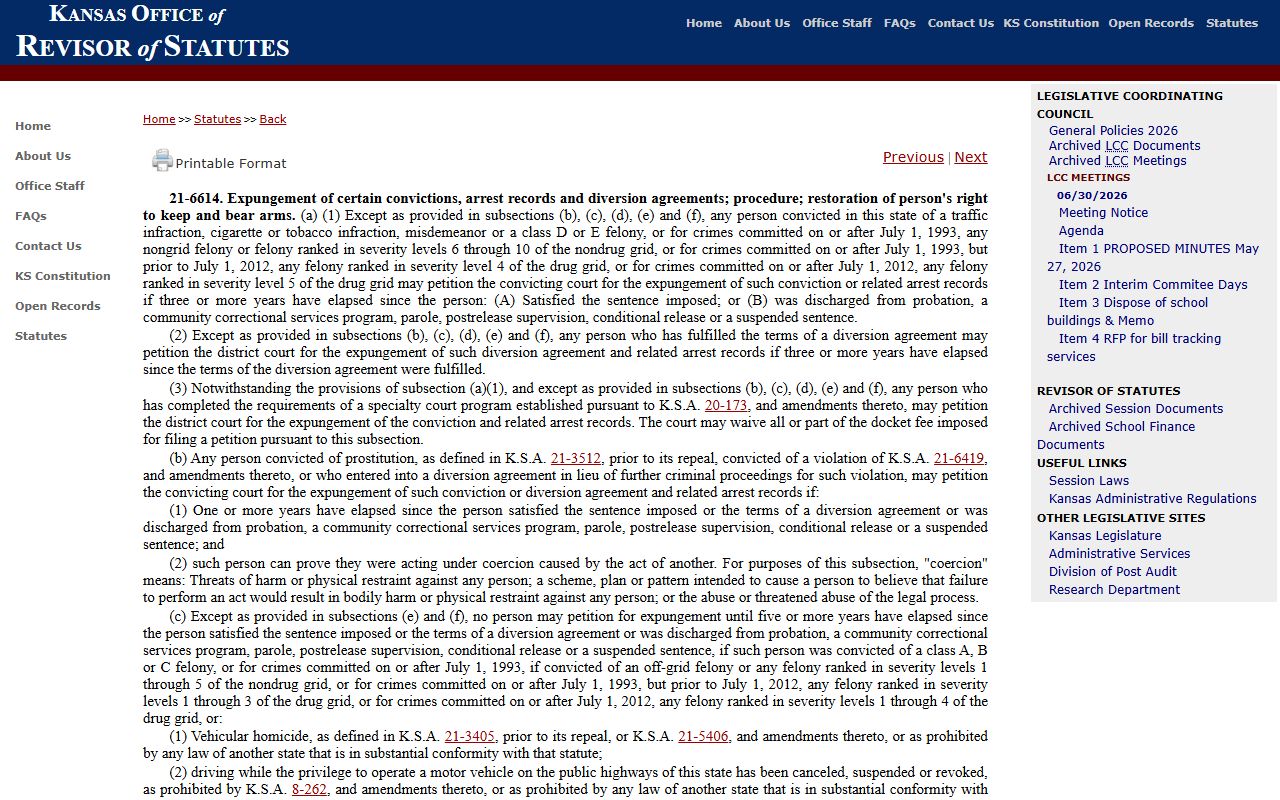
The Kansas expungement statute is K.S.A. 21-6614. A Montgomery County petitioner generally files in the court that handled the case and must give enough case detail for the clerk and prosecutor to identify the record. If an order is granted, public access is restricted, but expungement does not mean every government use disappears.
The Kansas expungement statute page is a primary source for the state law that controls eligible convictions, arrest records, and diversions.
| Point | Sealed | Expunged |
|---|---|---|
| How it happens | By statute, court rule, or judge's order closing a file or document. | By petition and court order when Kansas eligibility rules are met. |
| Public visibility | Not available through ordinary portal or public terminal access. | Public access is restricted after the expungement order. |
| Common examples | Juvenile, adoption, care and treatment, protected victim data, or sealed filings. | Eligible convictions, arrest records, or diversions under Kansas expungement law. |
| Government use | May remain available to the court or authorized agencies. | May still be used for certain government or legal purposes. |
Montgomery County Criminal Access Rules
Kansas public policy favors access to public records, but court access has limits. The Kansas Open Records Act includes K.S.A. 45-216, which states the public-records policy, and K.S.A. 45-220, which covers access procedures and copying. For court case records, Kansas Supreme Court Rule 22 is critical because it governs public electronic access to district and appellate case records and identifies categories that are not open through public electronic systems.
Access rule: Search public case information first, then request documents in writing from the Clerk of the District Court when the online record is incomplete.
Juvenile CINC records are closed to the public. Juvenile offender files may be open in some cases, but the court can close a file for a youth under 14 when closure is in the youth's best interest, and sex-offense victim information is not disclosed publicly. Adoption, care and treatment, some domestic or protection matters, sealed records, personal identifiers, and restricted victim or minor data may be withheld or redacted.
Montgomery County Public Defender
The state defender listing for Montgomery County points to the Southeast Kansas Regional Public Defender Office in Independence. The listing gives 400 N. 14th Street, Independence, KS 67301, phone 620-331-4329, and names Jay Witt as Chief Public Defender and Bryan Rickman as Lead Assistant Public Defender. Public defender eligibility and appointment are handled through the court and defender process. A person should not assume that calling the office alone creates representation in an active criminal case.
The state public defender directory is the current source used for the Independence regional office.
Criminal court records can also show bond supervision, probation, presentence investigation reports, and probation review events. Montgomery County Court Services operates at 300 E. Main Street, Basement Level, Independence, with local probation and court-support duties. Those details may appear in the court file when they affect hearings, bond, sentencing, or probation conditions.
Restricted Montgomery County Criminal Records
Not every criminal record is open online. Sealed cases, sealed documents, juvenile records, adoption records, care and treatment records, protected victim data, Social Security numbers, financial account data, and certain domestic or protection materials can be restricted or redacted. Rule 22 also means public electronic access can be narrower than clerk access, attorney access, or court access. If a case is not found online, that does not prove the case never existed.
For records not found in CaseSearch, use the originating office. District Court case files go to the Clerk of the District Court. County administrative records go through the Montgomery County open-records channel. State prison or supervision location is searched through KDOC KASPER. A statewide criminal-history summary comes from KBI. Federal criminal cases are separate and belong to the U.S. District Court for the District of Kansas, not Montgomery County District Court.
Important: Criminal court record lookups are not FCRA consumer reports and should be verified with the court before legal use.