
Marriage Licenses Through District Court
Marriage licenses in Montgomery County are handled through the District Court system, not the County Clerk's general county-government office. The 14th Judicial District maintains a local marriage license page, and the Clerk of the District Court is the local court-records office for marriage license questions. Montgomery County District Court has an Independence office at 300 E. Main Street, Suite 201, Independence, KS 67301, phone 620-330-1070, and a Coffeyville office at 102 W. 7th Street, 3rd Floor, Coffeyville, KS 67337, phone 620-251-1060. Public counter hours in the research file are Monday-Friday 8 a.m.-noon and 1 p.m.-4 p.m.
Kansas marriage license applications are accepted online through the Kansas Judicial Branch marriage license system. Applicants should expect to provide details for each person and an email address because licenses are issued electronically. Kansas has a 3-day waiting period after application before issuance, and a Kansas marriage license is generally valid statewide and valid for 6 months after issuance. Kansas no longer requires a blood test. After the ceremony, the license must be returned and recorded; official Kansas county examples identify a 10-day return window, but the local Montgomery research did not capture a separate Montgomery-specific answer.
How to Apply for a Marriage License
Use the statewide Kansas online marriage application and keep the Montgomery County District Court contact information available for local handling questions. Because the license is issued electronically, the email address entered in the application matters. Applicants should not assume the license is usable immediately after submission because the 3-day waiting period applies before issuance.
- Open the Kansas Judicial Branch marriage license self-help page.
- Complete the online application with details for both applicants and a valid email address.
- Pay through the online application system. The exact Montgomery County marriage license fee was not captured in the research, so verify the current amount with the Clerk of the District Court before relying on any fee figure.
- Wait the required 3 days after application before issuance.
- Use the license within its 6-month validity period and make sure the completed license is returned for recording after the ceremony.
The official Kansas marriage license self-help page is the statewide application source.
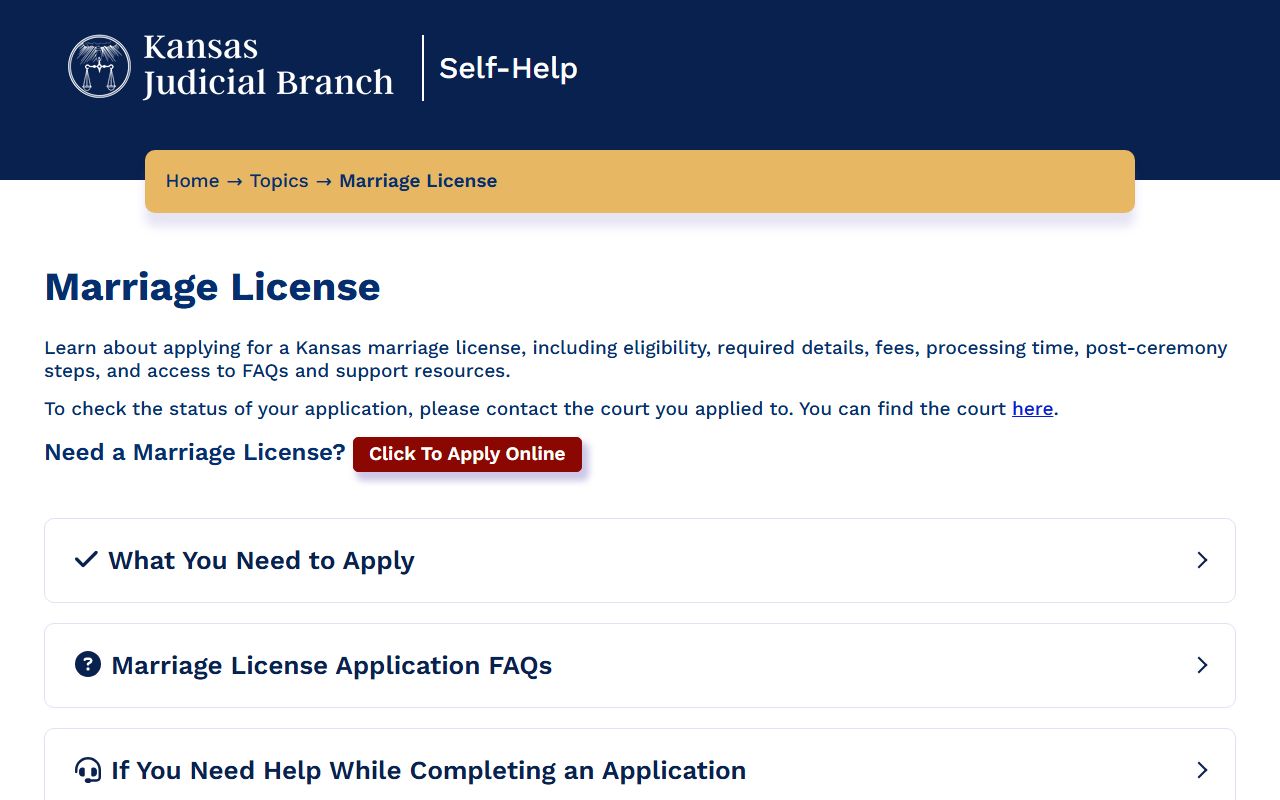
That statewide application source should be paired with Montgomery County District Court contacts for local questions about issuance and recording.
Marriage License Application Fields
The research capture identified the statewide online application at a high level, but did not capture every individual field label. Applicants should expect required details for each person, an email address, payment, and a county or court selection path in the Kansas court system. Because the license is electronic, entering a correct email address is part of the practical record process, not just a contact preference.
| Field | Required | Notes |
|---|---|---|
| Applicant details | Yes | Required details for each person; exact public field labels were not captured in the research. |
| Email address | Yes | Used because Kansas licenses are issued electronically. |
| Payment | Yes | Online payment is part of the statewide process; Montgomery County's exact local fee was not captured. |
| County or court selection | Likely | Use the Kansas court system and verify Montgomery County handling with the Clerk of the District Court if uncertain. |
Montgomery County Marriage and Divorce Fees
Only verified fee amounts should be published. The research captured KDHE's divorce certificate charge, but it did not capture a Montgomery County marriage license fee, local divorce filing fee, or District Court copy/certification fee from the court fee PDF. Kansas examples elsewhere may show common marriage-license amounts, but the Montgomery-specific amount was not visible in the local source capture and should not be invented.
| Item | Verified Amount | Notes |
|---|---|---|
| Montgomery County marriage license | Not captured | Verify with the Clerk of the District Court before publishing or relying on a fee. |
| KDHE divorce certificate | $20 | KDHE states walk-in certified divorce certificate copies cost $20 each. |
| District Court divorce filing | Not captured | Research notes a fee gap and recommends inspecting the current docket fee PDF. |
| District Court certified decree copy | Not captured | Request current copy/certification costs from the Clerk of the District Court. |
How to Look Up Marriage Records
Marriage records can mean the license record in the District Court system or a certified state vital certificate. For local court handling, contact the Montgomery County Clerk of the District Court at the Independence or Coffeyville District Court office. For a certified Kansas marriage certificate, use the Kansas Department of Health and Environment Office of Vital Statistics. KDHE maintains Kansas births, stillbirths, deaths, marriages, and divorces for eligible requesters.
When asking the court about a local license record, provide both names, approximate application or ceremony date, and any known license or case number. For a KDHE certificate, follow KDHE eligibility, identity, and order-channel requirements. A certificate is often used for benefits, name changes, and official proof. A court file or license record is the local court record and may be needed for different purposes.
How to Find Divorce Records
Divorce cases are filed in District Court. K.S.A. 23-2703 requires either the petitioner or respondent to have been an actual Kansas resident for 60 days immediately before filing. Divorce case files may include pleadings, summons, orders, decree, custody and support documents, payment records, and docket entries. Public access can be limited by Kansas Supreme Court Rule 22, privacy rules, sealed orders, and domestic-record restrictions. Sensitive information may be redacted even when part of the case is public.
The official Kansas divorce residency statute sets the 60-day residency rule.
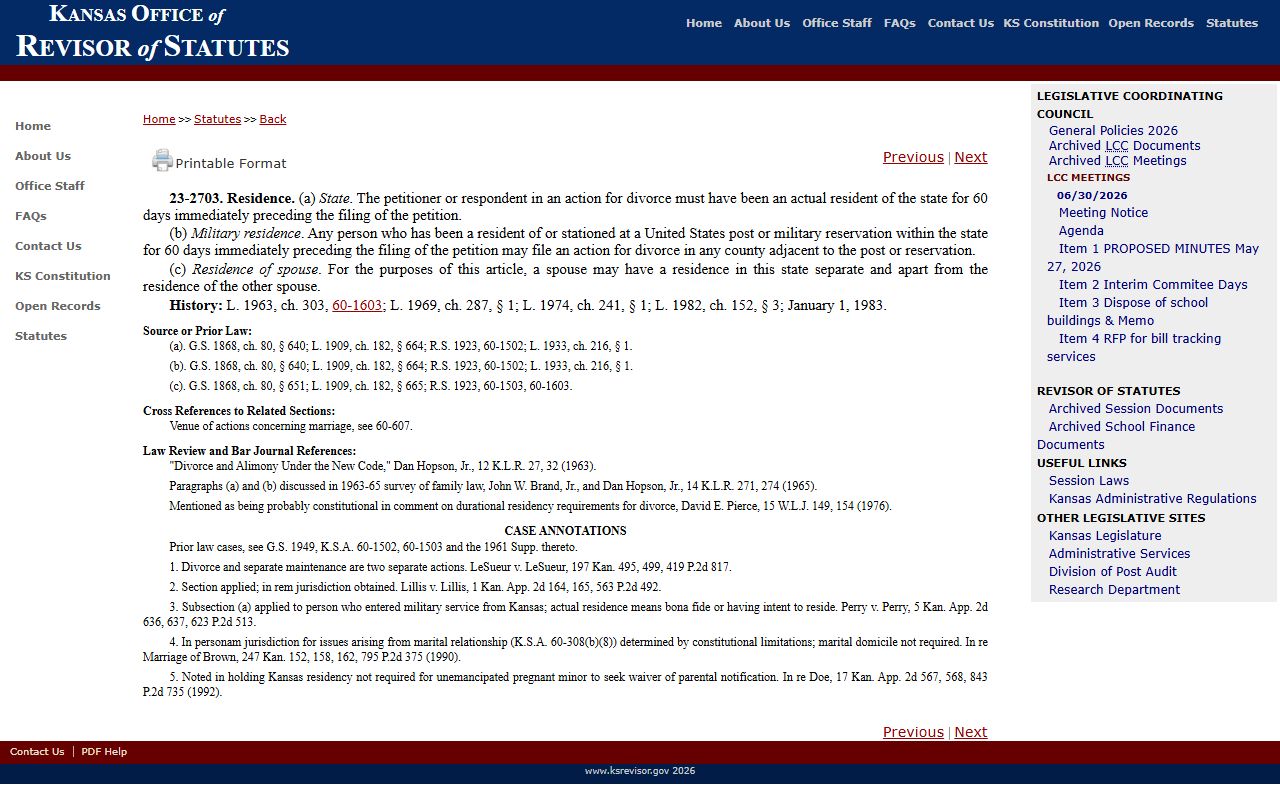
The residency rule affects filing eligibility; it does not decide whether a particular divorce record is publicly viewable.
Divorce Forms and Filing Steps
The Kansas Judicial Council provides official divorce forms and instructions, including separate paths depending on whether minor children are involved. The local 14th Judicial District FAQ says approved divorce forms are available from the Kansas Judicial Council and that district clerk offices no longer provide forms as of July 1, 2019. The practical local filing path is to confirm the 60-day residency requirement, choose the correct Judicial Council forms, file in the Montgomery County District Court office, pay the required filing fee or request a fee waiver if eligible, serve the other party unless a proper waiver or joint filing applies, and track orders through the court.
The District Court offices in Independence and Coffeyville are both relevant because Montgomery County has court offices in both cities. The Independence office is at the Judicial Center, 300 E. Main Street, Suite 201, and the Coffeyville office is at 102 W. 7th Street, 3rd Floor. Both public court-office hours captured in the research close from noon to 1 p.m., a local detail that matters for filing and records visits.
KDHE Certificate vs Court File
A divorce certificate from KDHE is a state vital-record summary. It is not the same as the full divorce case file or certified divorce decree from District Court. KDHE's divorce certificate page says walk-in certified copies cost $20 each, walk-in service is available 9 a.m.-4 p.m. Monday-Friday, and typical walk-in processing is 15-20 minutes if there is no difficulty locating the record. VitalChek is the internet channel for KDHE vital certificates.
The official KDHE Office of Vital Statistics page identifies the Kansas state vital-records office.
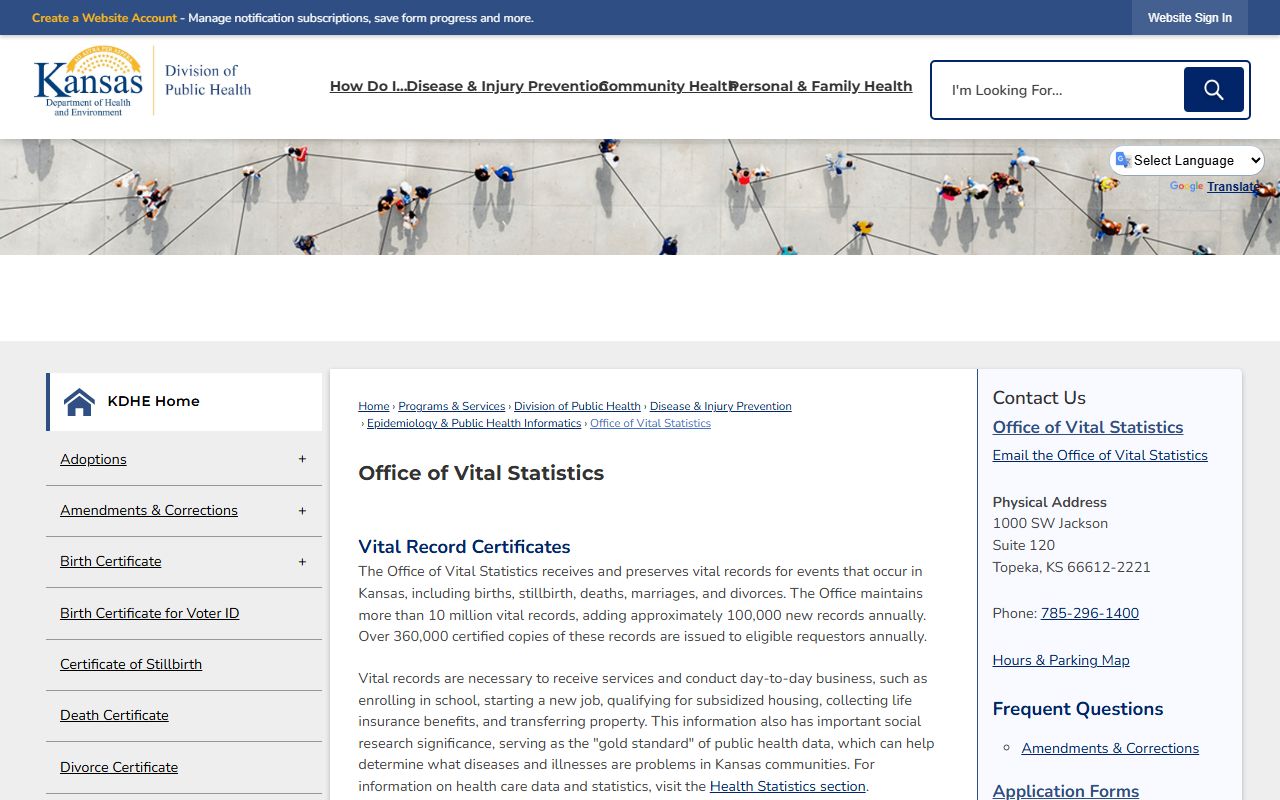
KDHE is the certificate source, while Montgomery County District Court is the source for local court filings and decrees.
The official KDHE divorce certificate page gives the certified copy cost and ordering context.
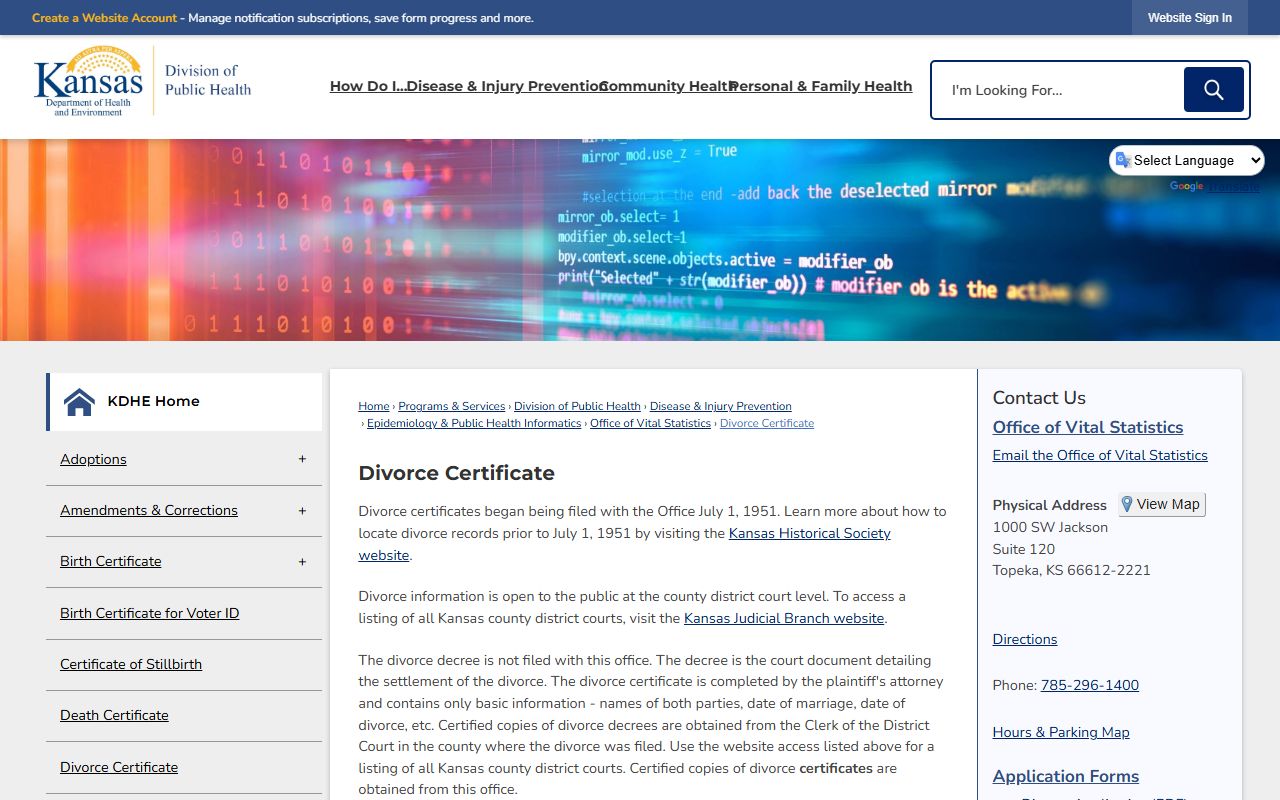
Use the KDHE divorce certificate channel when the needed proof is a state certificate rather than the underlying court decree or pleadings.
Domestic Record Restrictions
Kansas public access is not unlimited. K.S.A. 45-216 and K.S.A. 45-220 support public-record access and procedures, but court records are also governed by Kansas Supreme Court Rule 22 and category-specific restrictions. Domestic cases can contain protected personal identifiers, minor-child information, financial details, custody and support material, protection-order records, and other sensitive filings. Sealed records, expunged records, adoption records, care and treatment matters, and some protection or domestic records may be unavailable online or withheld from ordinary public review.
A requester who needs a divorce file should ask for specific documents rather than a broad domestic file dump. Provide the case number if known, party names, approximate filing year, document title, and whether a plain or certified copy is needed. If a document is restricted, the clerk may require a court order, party status, proof of identity, or a narrower request. KDHE certificate eligibility rules are separate from District Court file access.
Kansas Vital Records Office
KDHE Office of Vital Statistics is the state vital-records office for Kansas marriage and divorce certificates. For court filings, decrees, and local case records, use Montgomery County District Court. For county administrative records, use the County Clerk or county open-records channel. Keeping those offices separate prevents delays caused by sending a court-file request to the wrong office.
KDHE Office of Vital Statistics
Kansas Department of Health and Environment
State vital-record certificate office
Use KDHE posted order channels
Montgomery County District Court
300 E. Main Street, Suite 201
Independence, KS 67301
620-330-1070
Marriage licenses, divorce files, decrees, and domestic case records.