
Montgomery County Probate Scope
Probate in Montgomery County is not handled by a separate county probate court. It is a division and case type inside the 14th Judicial District, which serves Montgomery County and Chautauqua County. The district court hears estate administration, wills, guardianships, conservatorships, juvenile matters, small claims, civil cases, criminal cases, and other trial court work. That structure matters because probate papers are requested from the Clerk of the District Court, not from the Montgomery County Clerk.
Local research also points to Judge Rebecca Stewart as useful context for probate filings. The Judge Stewart biography says she is assigned to both counties in the district and that much of her caseload includes probate, bad debt, and traffic cases, along with criminal and juvenile matters in Chautauqua County. That does not mean each estate is assigned to one judge forever. It does show that probate is a regular local District Court workload rather than a side function of a county administrative office.
The official 14th Judicial District FAQ is the main local source for will filing and small estate questions. It explains that a will may be filed with the District Court office in the county where the decedent last lived, and that an Affidavit of Filing of the Will is filed with it. The FAQ also says estate probate without a will and guardianship or conservatorship actions require legal advice.
The local FAQ page is shown in the assigned source image from the 14th Judicial District FAQ.
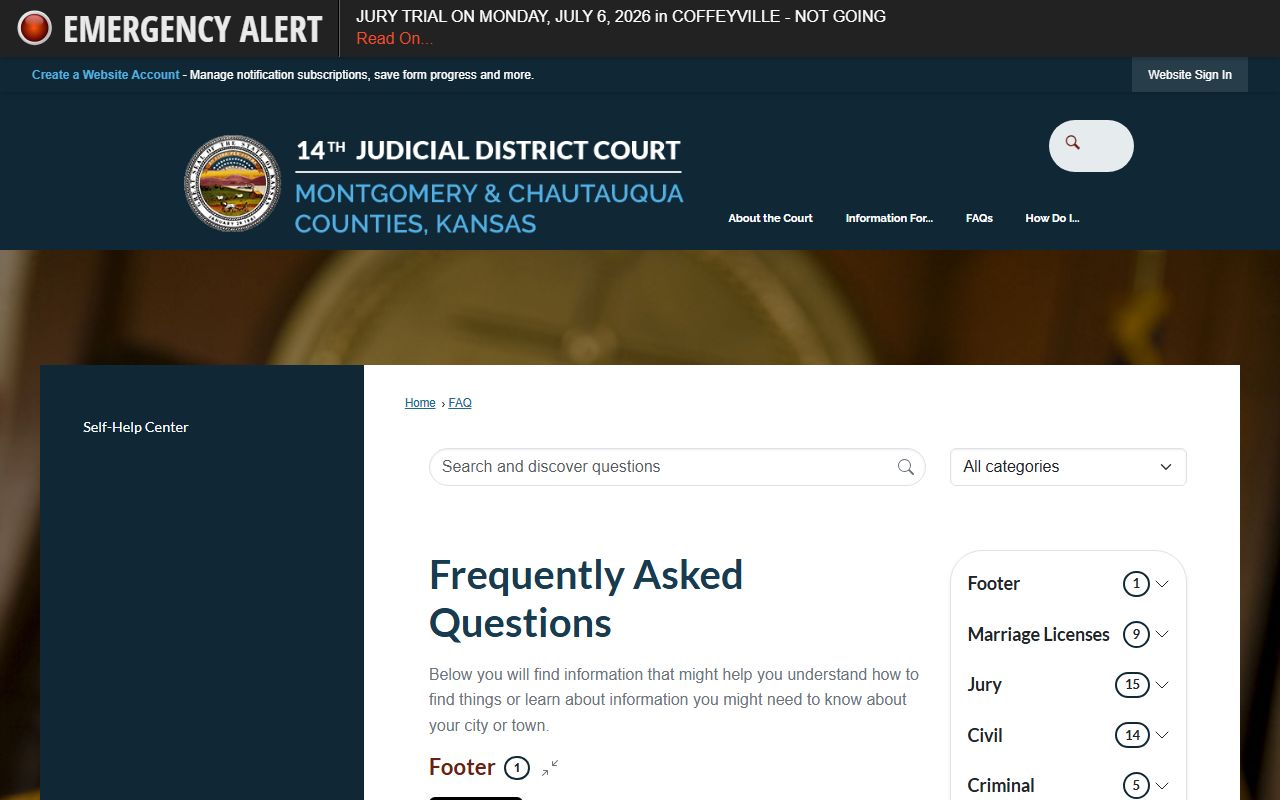
That FAQ is important because it separates simple will deposit steps from estate, guardianship, and conservatorship proceedings that may need legal counsel.
Montgomery County Probate Terms
Probate files use words that are short but easy to misread. These definitions help identify what kind of Montgomery County probate record or filing is being requested. They are not a substitute for advice about whether a specific estate needs to be opened, but they help with clerk requests and online searches.
- Testator
- The person who made a will before death.
- Executor
- The person named in a will to carry out estate duties, subject to court approval.
- Intestate
- A death without a valid will, so estate transfer follows Kansas law and court orders.
- Guardianship
- A case asking the court to appoint someone to make personal decisions for another person.
- Conservatorship
- A case asking the court to appoint someone to manage another person's money or property.
Search Montgomery County Probate Records
Public probate case data may be searched through Kansas CaseSearch when the case is public and electronically available. CaseSearch is the statewide Kansas district court search tool, and probate is a District Court case type. Search by case number when known. If the case number is unknown, use a party name, decedent name, estate name, or other available public criteria. Older estate files, image copies, and restricted material may not appear online.
A public terminal is another access channel. Kansas court materials state that each courthouse has a computer reserved for searches of court case information and court records. In Montgomery County, use the District Court office in Independence or Coffeyville for probate matters. If the online case result does not include the document image needed for a bank, title company, heir, fiduciary, or attorney, the next step is a written request to the Clerk of the District Court.
- Start with CaseSearch and search the Montgomery County District Court probate case by case number or name.
- Check the case type, filing date, party names, docket entries, and whether any public documents appear online.
- If the file is not online, identify the decedent, case number, approximate year, and document needed.
- Submit the District Court public records request form online, by mail, or by fax to the clerk.
- Ask the clerk to verify current docket, copy, and certification fees before payment because the exact fee PDF amounts were not captured.
Note: Guardianship and conservatorship files can include sensitive medical or financial details, so public access may be limited or redacted.
Montgomery County Probate Offices
Because the Probate Division is part of the District Court, probate users deal with the same local court offices that handle district case records. Montgomery County has District Court offices in Independence and Coffeyville. Both are listed by the 14th Judicial District as court offices for Montgomery County, and both use public hours that close for the noon lunch period.
Montgomery County District Court, Independence
300 E. Main Street, Suite 201
Independence, KS 67301
620-330-1070
Fax: 620-331-6120
Monday-Friday 8:00 a.m.-12:00 noon and 1:00 p.m.-4:00 p.m.
Montgomery County District Court, Coffeyville
102 W. 7th Street, 3rd Floor
Coffeyville, KS 67337
620-251-1060
Fax: 620-251-2734
Monday-Friday 8:00 a.m.-12:00 noon and 1:00 p.m.-4:00 p.m.
The Judge Stewart biography image assigned to this page comes from the 14th Judicial District biography page.
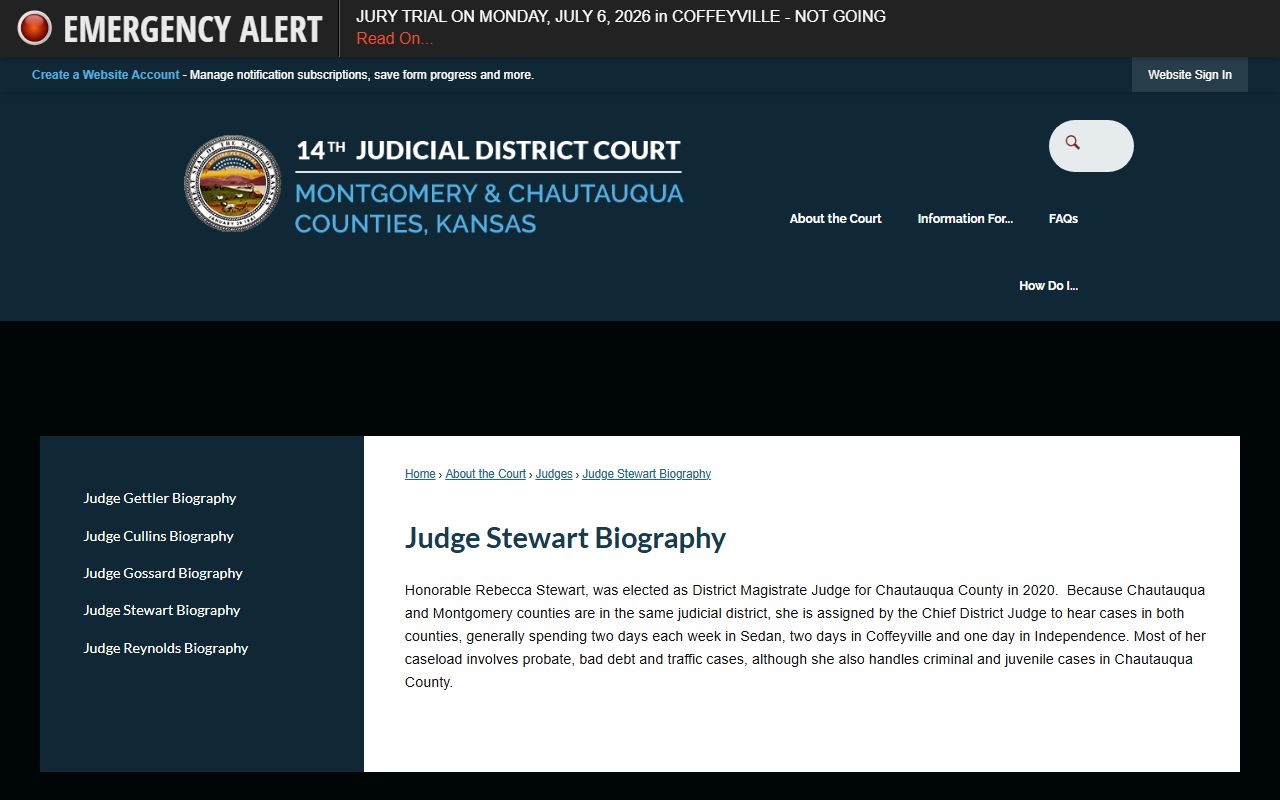
The biography helps explain why probate work is visible in the local court's ordinary District Court caseload.
Montgomery County Probate Filings
A will can be filed before a full estate case is opened. The local FAQ says any person who has a decedent's Last Will and Testament may file it in the District Court office of the county where the decedent last resided. The Affidavit of Filing of the Will must be filed too. The court takes no further action from that filing alone. The point is to preserve the will if a probate case is later needed.
Small estate affidavits are different. The local FAQ says Small Estate Affidavit forms are available through the Kansas Judicial Branch or Kansas Judicial Council legal forms resources. A small estate affidavit may help with limited property transfer when formal estate administration is not required, but the clerk cannot give legal advice about whether it fits a particular estate. For contested estates, estates without a will, guardianships, or conservatorships, the FAQ recommends legal advice.
| Probate Need | Local Source Guidance | Practical Request Detail |
|---|---|---|
| File a will | File in the District Court office of the decedent's last residence county. | Bring the will and Affidavit of Filing of the Will. |
| Preserve a will | No court action occurs from filing alone. | Ask for a receipt or filing confirmation if needed. |
| Small estate affidavit | Forms are available through Kansas court legal forms resources. | Verify whether the form fits the estate before use. |
| Estate without a will | The local FAQ says legal advice is required. | Use case number, decedent name, and filing year when requesting records. |
| Guardianship or conservatorship | The local FAQ says legal advice is required. | Expect sensitive information and possible access limits. |
Montgomery County Probate Fees
Probate filings can involve docket fees, copy fees, and certification charges. The local FAQ confirms that a docket fee is due when a will and Affidavit of Filing of the Will are filed. The research also found that the local docket page links a court fee schedule PDF, but the exact current amounts were not captured. Probate fee amounts should therefore be checked from the current court fee PDF or with the Clerk of the District Court before a filing or copy request is sent.
| Item | Amount or Status |
|---|---|
| Will filing docket fee | Required, amount must be verified from the current court fee PDF. |
| Estate or probate case docket fee | Must be verified with the Clerk of the District Court. |
| Guardianship or conservatorship filing fee | Must be verified with the Clerk of the District Court. |
| Plain copy fee | Exact amount not captured, verify before ordering. |
| Certified copy fee | Exact amount not captured, verify before ordering. |
Montgomery County Probate Records Show
A probate file may show the petition or application that opened the case, the will, affidavits, notices, orders, letters of appointment, inventories, accountings, receipts, claims, distribution papers, and final orders. Guardianship and conservatorship files may also include reports, financial information, capacity facts, medical references, and court orders about who may act for another person. The public docket can show filed events without exposing every document image.
For a certified copy, use exact terms. A bank, title office, or agency may need a certified order, certified letters, or a certified copy of a will rather than a plain docket printout. If the case is part of a broader family matter, use the Montgomery County marriage and divorce records page for domestic record context, and use the Clerk of the District Court page for more detail on written court-record requests.
Restricted Montgomery County Probate
Kansas public access rules allow access to many court records, but probate access is not all or nothing. A public estate docket may be searchable while a document image is withheld. A guardianship or conservatorship file may contain health, money, minor, or protected-person details that are redacted or restricted. Sealed records and sealed cases are not public through the portal or courthouse terminal.
When a record is not available online, the best request is narrow. Provide the case number if known, the full name of the decedent or protected person, the approximate filing year, and the document title. If the clerk cannot release a document, ask whether a redacted copy, docket entry, or court order is public. Probate users should also distinguish court probate records from county land, tax, or deed records, which may be held by other county offices.